
No Roanoke City 72-Hour Feed
No official Roanoke City Sheriff interface offered a rolling 72-hour release list during the August 2026 review. There is no distinct URL, no official three-day result set, and no published cadence or retention policy. The city’s Resident Search serves current detention. Police arrest news, court dockets, VINELink results, and commercial rosters measure different events and cannot be assembled into an official local release list.
A three-day inquiry is still possible, but the source must change. Follow the Sheriff’s FOIA instructions and ask for existing release or movement entries within an exact start and end time. That request may cross several calendar dates. If no compiled interval report exists, Virginia FOIA does not require the office to create one. A request for an identified person’s record is more direct and easier to verify.
Note: Roanoke City publishes no rolling three-day release feed, so the requested date range must be stated precisely.
Check Roanoke City Three-Day Releases
Start by fixing the window. “Last 72 hours” is not the same as the last three calendar dates. Write down the beginning and ending time, including the local time zone, before contacting the detention center. Roanoke City Adult Detention Center can be reached at 540-853-2621. The caller should ask which office handles the release or transfer record.
- Set the exact 72-hour beginning and end. Keep both dates and times with the request.
- Use the official Resident Search to see whether a named person is currently marked “In Custody.” Do not treat a missing row as proof.
- Call the detention center with the full name and any known birth date, State ID, Inmate ID, booking number, or commitment date.
- Request existing records showing the actual release or transfer date and time, legal authority, facility, and destination.
- Use the correct Roanoke City court case to understand bond, dismissal, sentence, or time served. Then follow VADOC or another agency if the event was a transfer.
The Roanoke City 24 hour release list process is the better route for a same-day event. It narrows the time span and emphasizes immediate confirmation rather than weekend catch-up.
Roanoke City Three-Day Record Fields
Roanoke City publishes no official 72-hour feed fields. The fields below identify what to seek in the underlying Sheriff record. Each item serves a distinct purpose. The agency may redact material or may not keep every item in the same record, so frame the table as a request checklist.
| Field to request | Reason it matters |
|---|---|
| Name and booking number | Ties a three-day result to the right person and detention event. |
| Booking or commitment time | Separates an older booking from a recent movement. |
| Actual release or transfer time | Places the event inside or outside the defined 72-hour window. |
| Release authority or type | May distinguish bond, dismissal, time served, sentence completion, or another basis. |
| Bond and court information | Points to the judicial record that may explain the custody change. |
| Destination or receiving custodian | Shows whether the person entered the community or remained confined elsewhere. |
| Sentence computation or jail credit | Can explain a local sentence-completion event when those records apply. |
A release type must be read with care. Bond can end pretrial confinement while the case continues. Time served ends the confinement portion, though other terms may remain. Transfer means custody changed hands. It is not release to the community.
Roanoke City Weekend Release Checks
A 72-hour span often crosses nonbusiness hours even though the detention center operates continuously. That matters for the verification route. A court order, bond transaction, records update, physical exit, and receiving-agency intake may occur at different times. The three-day window should use the Sheriff’s actual release or transfer time, not the date a court entry appeared online.
Virginia Code § 53.1-116 contains local discharge timing provisions, including rules for an eligible release date that falls on a Saturday, Sunday, or legal holiday. It also refers to discharge before noon under its terms. Those provisions do not prove the exit time of every Roanoke City resident. Holds, new orders, transfer arrangements, or a different sentence structure can affect the result. Ask for the specific computation and release entry.
When a court clue is needed, choose Roanoke City, not Roanoke County. General District Court handles local misdemeanors and preliminary felony matters, while Circuit Court handles felonies and appeals. A disposition can explain the legal cause, but only the custodian can confirm the physical move.
Note: Office closure does not mean jail processing stopped, but documentary follow-up may wait until the next business day.
Request Roanoke City Release Records
The Sheriff’s Records Section is the durable local route after a person leaves the current display. The office develops and maintains correctional-status and conviction data, examines court documents, prepares sentence computations, and manages storage or destruction under legal rules. Its public description does not state how long a former resident remains visible online.
A focused request should identify the person and ask for existing records showing booking date, actual release or transfer date and time, release authority, releasing facility, bond details if recorded, destination, sentence computation, and jail credit. If the request seeks all movements in the 72-hour span, say so plainly and acknowledge that the office need not create a new report. Ask for an advance cost estimate.
Under Virginia Code § 2.2-3704, an agency generally issues one of the statutory responses within five working days. A written explanation may invoke added time when a response is not practical within that period. The response can provide records, cite a withholding, supply redacted records, report that records were not found, or identify a known custodian.
The complete named-person route appears on the Roanoke City released inmates page. It covers city, state, federal, and immigration systems without treating one roster as universal.
Roanoke City Roster Window Limits
The Resident Search result shows First Name, Last Name, State ID, and Inmate ID. Its detail view may show name, race, sex, commitment date, bond type and amount, charge dates and codes, descriptions, and an image. It has no release tab, release-date field, release reason, or 72-hour filter. Returned records observed during research were labeled “In Custody.”
The official current Resident Search is shown below as a source-matched capture.
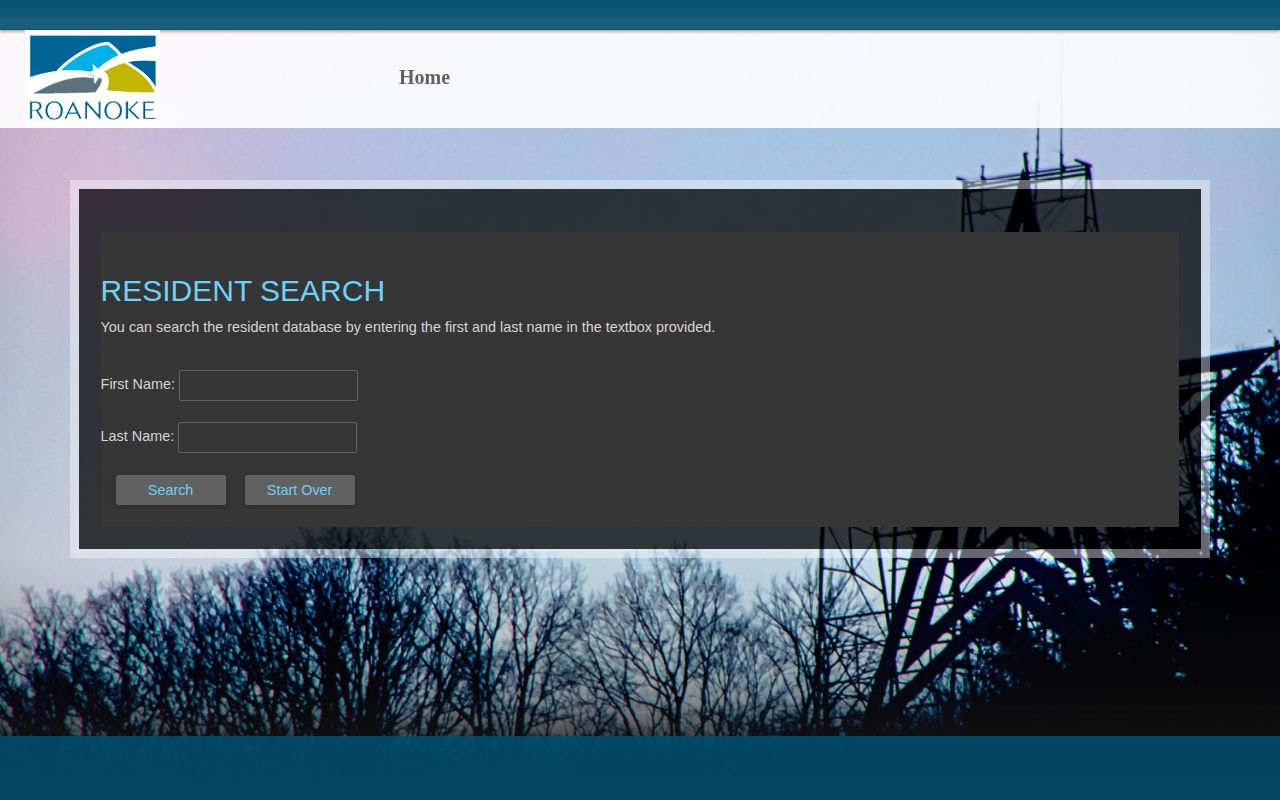
The interface is useful at the start of a three-day review because it can show who is currently held. It cannot reveal who left on each of the prior three days. Its update cadence and former-resident retention period are not published.
Note: A current roster can narrow the inquiry, but only an affirmative movement or release record confirms departure.
Roanoke City Release Cross-Checks
Cross-checks help resolve what happened after a city row changed. Virginia Jail VINE can send a future custody-change alert for a matched local record. Verify the alert because it may reflect transfer. VINE is a notification service, not a complete history of everyone released during the prior 72 hours.
If the Sheriff reports a transfer into state custody, use the VADOC Inmate and Supervisee Locator. A state record does not cover every short city-jail stay. For a federal judgment, use BOP. An ICE locator no-result is not a historical release record. Each system must be tied to the correct custodian.
- Release
- The person left the named custody under recorded legal authority.
- Transfer
- The person moved to another custodian and may remain confined.
- Disposition
- The court’s outcome on a charge or case, which may explain but not time the jail exit.
- Detainer
- A request or authority that can cause another agency to take custody when local confinement ends.
The three-day method is strongest when its timeline records every source’s exact wording and access time. Contradictions should be resolved with the most recent custodian and the underlying release or movement entry.
Do not merge unrelated events just because they fall within the same three days. An arrest report marks police activity. A court docket marks judicial action. A VINE alert marks a reported custody change. A Sheriff release entry marks the city jail’s physical transition. If one person has several bookings or cases, match each event by booking number, case number, and date. Then note whether the destination was the community, VADOC, another jail, a federal authority, or another custodian. This event-by-event method produces a defensible 72-hour record set even when Roanoke City publishes no online interval list.
A request can also ask whether the named records series is still held. The Records Section says it follows legal rules for purging, storage, and destruction, but it does not publish a web retention period. Asking the custodian about the specific series is more accurate than assuming a former resident stays searchable for three days. If records cannot be found, preserve the agency’s response and check whether it identified another known custodian.